
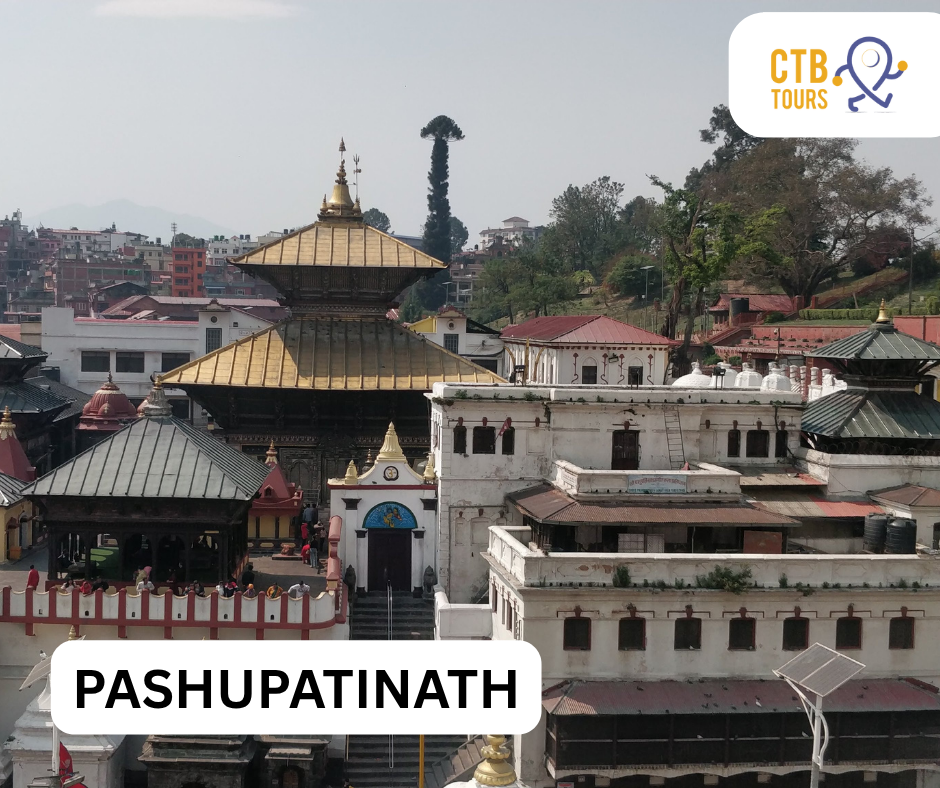
Pashupatinath -Shri Pashupatinath Temple is a revered Hindu temple dedicated to a manifestation of Lord Siva. The holy Pashupatinath temple is located at a divine place next to the bank of the Bagmati River facing the Aryagath (Hindu open-air cremations) in Kathmandu. This temple is one of the oldest and most significant religious complexes in South Asia. Mythologically the temple is seen & believed as the head of Lord Siva, with his body stretching to the Kasi Visvanatha temple in India.
Kopan Monastery Table Of Contents
History Of Pashupatinath Temple
As a proud Nepali, there’s nothing more fulfilling than introducing the world to the divine story of Pashupatinath Temple—Nepal’s most sacred temple dedicated to Lord Shiva. This holy site is not just a religious symbol; it’s the soul of Kathmandu and a testament to our deep-rooted spirituality and devotion.
Origin of Pashupatinath Temple
Where Divinity Touched the Earth
According to ancient legends, Lord Shiva, seeking solitude from the celestial realm, came to the Bagmati River valley disguised as a deer. Enchanted by the peaceful surroundings, he refused to return. The gods, upon discovering him, forcibly retrieved him, breaking one of his antlers in the process. That antler transformed into the first Shiva lingam, marking the divine foundation of what would become Pashupatinath Temple.
This mythological tale roots the temple’s spiritual significance deep into the beliefs of the Nepali people and millions of devotees worldwide.
Early Development and Construction
While exact dates are uncertain, historical records and inscriptions suggest:
- The site was considered sacred as early as the 1st century BCE.
- The first documented structure was built in the 5th century CE by Lichhavi King Supuspa.
- The original structure was a simple shrine, later transformed through various dynasties.
| Time Period | Key Development |
|---|---|
| Pre-5th Century CE | Site held sacred based on oral tradition and the Shiva legend |
| 5th Century CE | The first temple constructed by the Lichhavi King Supuspa |
| 11th Century CE | Reconstruction and stylistic evolution under local rulers |
| 14th Century CE | Partial destruction during Muslim invasions; rebuilt by local kings |
| 17th Century CE | The current structure was developed under King Bhupatindra Malla |
| 1979 | Recognised as a UNESCO World Heritage Site |
Right Time To Visit Pashupatinath Temple
Visiting Pashupatinath Temple is not just about witnessing architecture or ancient rituals—it’s about feeling the heartbeat of Nepal’s spiritual core. As a proud Nepali, I always say that the best time to visit depends on what you’re seeking: sacred energy, calm reflection, or vibrant cultural immersion. Let me walk you through the seasons and spiritual timings to help you plan a meaningful journey.
Best Time of Year to Visit Pashupatinath Temple
| Season | Months | Experience Highlights |
|---|---|---|
| Spring | March–May | Pleasant weather, blooming surroundings, ideal for exploration and spiritual tours |
| Summer/Monsoon | June–August | Fewer crowds and lush greenery, but high rainfall may hinder outdoor movement |
| Autumn | September–November | Clear skies, festive atmosphere, and the best for photography and temple experiences |
| Winter | December–February | Chilly mornings, fewer tourists, great for peaceful retreats and rituals |
Pooja Time In Pashupatinath Temple
- Opening Hours: Daily from 4:00 AM to 12:00 PM and 5:00 PM to 9:00 PM.
- Entry Restrictions: Only Hindus are permitted to enter the main temple sanctum.
- Best Time to Visit: Spring (March to May) and Autumn (September to November) offer pleasant weather and vibrant festivals.
- Attire: Modest clothing is recommended; shoes must be removed before entering the temple premises.
- Photography: Restricted in certain areas; always seek permission before capturing images.
Myth vs Facts of Pashupatinath Temple
Myth 1: Only Hindus can enter the Pashupatinath Temple
Fact: While only practising Hindus are permitted to enter the main sanctum of the temple, non-Hindus are welcome to explore the entire temple complex. The outer areas, including ghats, courtyards, and surrounding shrines, are open to all visitors who wish to experience the spiritual ambience.
Myth 2: The temple was built overnight by divine forces
Fact: Pashupatinath is rooted in ancient legend, but historical records trace its construction to the 5th century, with renovations and expansions done over centuries. The temple’s sacredness may feel divine, but its architecture is very much a result of rich history and craftsmanship.
Myth 3: Pashupatinath is dedicated only to Lord Shiva
Fact: Though Lord Shiva as Pashupati is the central deity, the temple complex includes numerous shrines dedicated to other gods and goddesses, like Parvati, Vishnu, Ganesh, and more. It is a holistic spiritual centre honouring the full spectrum of the Hindu faith.