
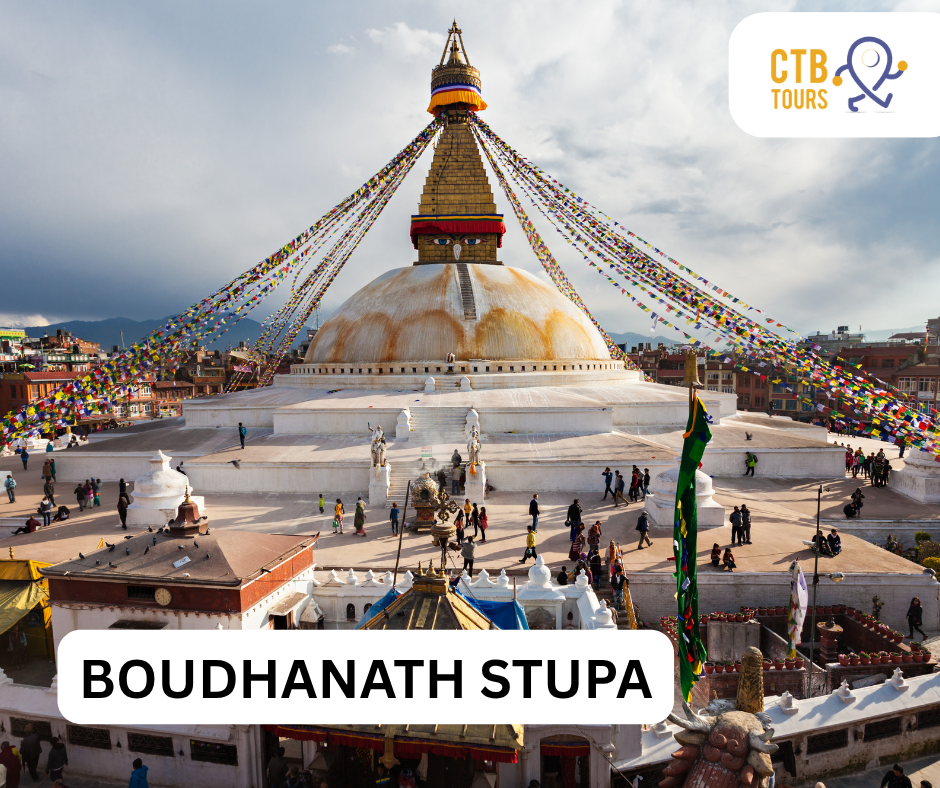
Boudhanath Stupa “Jarung Kashor” also known as Khasti Chaitya is major, one of Nepal’s must-visit attractions and a spiritual highlight of any trip to Kathmandu. It is located in Boudhanath, within the city of Kathmandu, and has a massive Mandala that makes it the largest spherical stupa in Nepal and one of the largest in the world. The Stupa dates from 600AD and was built by a Tibetan king. The stupa is a historical pilgrimage site for all the Buddhists around the world.The stupa was built using many kilograms of gold for decoration. The gaint Boudhanath stupa is a gateway to heaven serving as a horizon between the earth and sky. It is recognized as a UNESCO World Heritage Site and Boudhanath is a hub for Tibetan Buddhism and a perfect place to explore Nepal’s rich culture, enjoy local food, shop for souvenirs, or simply soak in the spiritual vibe.
History Of Boudhanath Stupa
In the later part of the 5th century, during the reign of King Dharmadeva of the Licchavi dynasty, a water crisis struck the Kathmandu Valley. The royal astrologers advised that only the sacrifice of the most virtuous man could restore the flow of water in the kingdom. After searching the entire kingdom, the king realized the only worthy choices were himself and his son. For the good of his kingdom, King Dharmadeva instructed his son, Prince Manadeva, to decapitate a shrouded figure he would find near the palace at night, without revealing it was him.
Obediently, the prince carried out the act, only to watch in horror as his father’s head flew through the air and landed at the Vajra Yogini temple in Sankhu. The goddess Vajra Yogini appeared and told the grieving prince that he could atone for his actions by letting a rooster fly and building a stupa where it landed.
The rooster landed at Boudha—and so, the great Boudhanath Stupa was born. Later, the stupa became part of an ancient trade route that linked Tibet to Kathmandu, making it a vital spiritual stop for merchants and travelers.
The Legend of Jarung Kashor
According to Tibetan legend, the grand Boudhanath Stupa was built by an old widow (called Samvari or Jhyazima) who worked in a poultry farm and had 4 sons. She was a devout Buddhist, she wished to honor the Buddha by burying his remains and constructing a stupa. So, she requested land from the king to build the stupa. The king gave her permission, but had a condition that she could build the stupa only on land as much as a buffalo/ox skin would cover. But the woman cleverly cut the skin into a long strip and marked a vast circular area. With help from her four sons, she laid the foundation of the stupa. Seeing such a large area of land being given to the widow, the people in the king’s palace tried to stop her by requesting the King. Yet the king, bound by his word, he exclaimed, “Let it be done” (In Tibetan jarung) and the words “slipped from his tongue” (In Tibetan Kashor), hence the name Jarung Kashor. And thus, the mighty Boudhanath Stupa was born of faith, cleverness, and perseverance.
Right Time To Visit Boudhanath Stupa
Boudhanath Stupa is a beacon of peace and spirituality. As a proud Nepali, I always say that the best time to visit depends on what you’re seeking: sacred energy, calm reflection, or vibrant cultural immersion. Let me walk you through the seasons and spiritual timings to help you plan a meaningful journey.
Best Time of Year to Visit Boudhanath Stupa
| Season/Month | Weather | Highlights / Events | Travel Tip |
|---|---|---|---|
| Autumn (Sept–Nov) | Clear skies, mild temperatures | Ideal for walking, photography, and sightseeing | Peak tourist season – arrive early in the day |
| Winter (Dec–Feb) | Cold mornings, possible fog | Fewer crowds | Dress warmly; views may be limited by fog |
| Spring (Mar–May) | Pleasant, blooming flowers | Great weather; Buddha Jayanti in May | Good time for cultural exploration |
| Feb/March | Varies annually | Losar – Tibetan New Year celebrations, dances, and rituals | Check the lunar calendar for festival dates |
| Monsoon (Jun–Aug) | Hot, humid, frequent rain | Lush greenery but limited visibility and wet conditions | Carry rain gear; walkways may be slippery |
Pooja Time In Boudhanath Stupa
-
Opening Hours: Daily from 5:00 AM to 8:00 PM (Stupa area), and Monasteries are generally open until 6:00 PM.
-
Pooja Timing: Morning rituals begin at 5:30 AM, evening prayers from 4:00 PM to 7:00 PM
-
Entry Restrictions: Open to all visitors regardless of religion; respect prayer areas and monastic spaces
-
Attire: Modest clothing is recommended — cover shoulders and knees; avoid flashy or revealing outfits
-
Photography: Photography is allowed around the stupa, but avoid using flash inside monasteries. Always ask permission before taking photos of monks or worshippers.
Myth vs Facts of Boudhanath Stupa
Myth 1: The stupa was built overnight by supernatural forces
Fact: While many legends speak of a miraculous construction, historical evidence indicates that the stupa was built during the Licchavi period by devoted individuals under royal patronage. Its immense size and spiritual aura may feel otherworldly, but it is a product of community effort, craftsmanship, and devotion.
Myth 2: Only Buddhists are allowed to walk around the stupa
Fact: Boudhanath is open to everyone, regardless of faith. All visitors are welcome to perform the traditional ritual of kora (circumambulation), as long as it is done respectfully in a clockwise direction. The stupa represents peace, inclusivity, and universal spirituality.